Monday, July 21, 2014
Chocolate Juniper Cake with Milk Jam Sour Cream

I tend get my hackles up over use of the word "special." It so often smacks of faint praise, or overcompensation. Its possible Im a bit of a hater. But recently my friend Brian helped me come around. As good friends and neighbors, we end up eating a lot of meals together (and sharing too-good-not-to-bring-next-door bites of many more). And there have been times during these meals where hell just pause, savoring everything about a singular mouthful, and then pronounce it special.
Maybe its the fact that Brians a particularly dear friend, or the total wide-eyed sincerity with which he shares this reaction. Whatever it is, its helped me get over my surliness and embrace the word. Because hes right. Some things truly are special. Like this cake.
I first saw this cake posted on Bon Appetit, and figured that it was the sort of thing best left to the professionals. But then I saw it on a beloved blog, and thought perhaps it was within the mortal realm. And then I made it, and I shared it with my neighbors, and we moaned out some expletives about how holy crap good it was.
Amazingly, its not even all that complicated. The cake itself is just a simple two-bowl chocolate cake — you dont even have to remember to soften butter or anything. But there are a few simple steps that take it beyond. First off, the cake is scented with juniper berries (thankfully sold in bulk at the local natural market down the street), which manage to both deepen and cut through the chocolate with their unique woodsy vibe. Then you make a sauce that manages to be both milky-sweet and rich and tangy at the same time. And then — even better — you firm up the cake in the freezer, dredge it in sugar, and give it a quick pan-fry to yield a delicately caramelized crust. The end result makes you question all of your previous cake-making. Why isnt chocolate always paired with juniper? And milk jam sour cream served on everything? And seriously why isnt every cake caramelized prior to serving? None of these tweaks is all that difficult, and all are within the grasp of pretty much any cake-baking home cook. And the end result is really, really special.
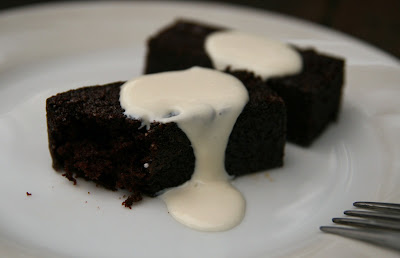
Chocolate Juniper Cake with Milk Jam Sour Cream
adapted from Oxheart, via Bon Appetit
serves ~10 (you can also halve the recipe and bake in an 8-inch pan instead)
Cake:
2 heaping teaspoons juniper berries
1 3/4 cups flour
1 2/3 cup sugar (plus more for caramelizing the cake)
1/2 cup plus 1 Tbsp cocoa powder
2 tsp coarse salt
1 1/2 tsp baking soda
3/4 cup buttermilk (if unavailable, substitute soured milk)
3/4 cup neutral oil, like vegetable or grapeseed
2 large eggs
Milk Jam Sour Cream:
1 cup sour cream or creme fraiche
1-2 Tbsp sweetened condensed milk (if youd like to make your own milk jam, boil down 2 cups milk with 1 cup sugar until youre left with a darkened, sweetened cup, ~45 minutes — and, as a bonus, leftover milk jam or sweetened condensed milk keeps for a while and is great stirred into your coffee)
To make the cake: Preheat your oven to 350° Farenheit. Grease a 9x13 pan, line the bottom with parchment and grease again, then dust everything with flour. Set aside.
Heat a dry skillet over a medium heat, then dry-toast the juniper berries until they become oily and fragrant (this will barely take a minute). Let cool slightly, then grind in a spice grinder.
In a large bowl, sift together the ground juniper berries with the flour, sugar, cocoa powder, salt, and baking soda. In a separate bowl, whisk together the buttermilk, oil and eggs until well combined. Pour the wet ingredients into the dry, and fold or whisk until just combined (dont over-mix). Quickly transfer to your prepared pan, smooth the top if needed, and bake until a tester comes out clean, ~35-40 minutes. Remove from the oven, let cool, then transfer to the freezer until solid, at least two hours and up to three weeks (if the latter, wrap well in plastic).
To make the milk jam sour cream: Stir the sweetened condensed milk or milk jam into the creme fraiche/sour cream to taste — you want something thats lightly sweet, but still quite tangy.
To finish the cake: Remove the cake from the freezer, turn out onto a cutting board and discard the parchment. Trim off the edges, then slice the cake down the middle, so that you have two rectangles of about 4-inches in height, then slice each rectangle crosswise into 1 1/4-inch bars.
Pour out some granulated sugar onto a plate, grab a pair of tongs if youve got them, and heat a pan over a medium heat (the recipe recommends nonstick, but I did this with a regular steel pan and it was fine). Roll each cake bar in the sugar, so that theyre well-coated with a thin-yet-thorough dusting. Working in batches, transfer the cake slices to the skillet. Let caramelize on each side, turning to expose the next side when the side in the pan has melted and caramelized (once your pan is hot, itll take less than 30 seconds per side). You can also caramelize the short ends if you are quite obsessive, but its not necessary. Serve straight from the pan, with a dollop of milk jam ladled over the top.

Sunday, July 20, 2014
Poached Salmon with Cucumber Sauce
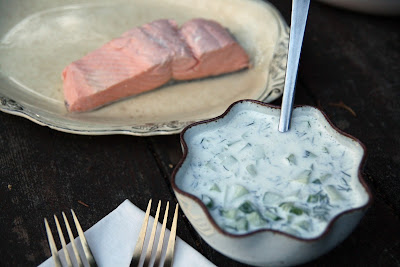
Salmon and cucumber seems like a combination from a long time ago. Im not sure if I come by this opinion from my own personal history, or obsessive reading of old cookbooks (its hard to tease apart the two sometimes). Regardless, it pulls up thoughts of gelatin-set salmon molds, of cucumber slices made to look like fish scales, and other tropes that were the height of luncheon catering some twenty-five years past. But I clearly need to readjust my thinking. Because poached salmon with cucumber sauce is a timeless combination. Its what I had for dinner last night, and last week as well. And what I should be having once a week every summer.
The inspiration for this particular incarnation of the classic comes from the always-in-style Julia Child. And it couldnt be simpler. Salmon is slipped into a barely-simmering bath of water, where it manages to delicately set without overcooking (and, thanks to a generous helping of salt and vinegar, doesnt wash out but instead gains even more flavor). And then it is served with a cool, slippery sauce (if you could even call it that) of sour cream, Greek yogurt, cucumbers and dill. Pair it with a simple summer salad (I went with arugula, peaches and corn), maybe a chunk of leftover bread for sopping up the plate, and youve got a summer meal thats just about perfect. Timeless, even.
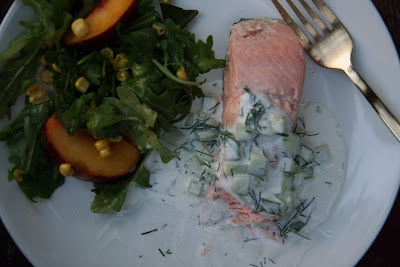
Poached Salmon with Cucumber Sauce
inspired by Julia Childs The Way to Cook
serves 4
Cucumber Sauce:
1/2 cup sour cream
1/2 cup Greek yogurt (not nonfat)
1/2 teaspoon sugar
1/2 teaspoon coarse salt
1/2 teaspoon vinegar (cider or sherry work well)
1 cucumber, chopped in a 1/4-inch dice
~2-3 tablespoons chopped fresh dill
1 pound salmon, cut into 4 slices
salt and white vinegar (see below)
To make the cucumber sauce: In a bowl, stir together the sour cream, Greek yogurt, sugar, salt and vinegar until well combined. Taste, and adjust as needed. Stir in the cucumber and dill, and set aside to chill while you prepare the salmon.
To prepare the salmon: Pour water into a very deep-walled saucepan, or wide-bottomed pot, to a depth of three inches. For every quart of water this requires, add 2 teaspoons coarse salt, and 3 tablespoons vinegar. Bring to a boil, then slip in the salmon, and adjust the heat so that it is just barely about to simmer. Cook at this level until done, meaning it has a bit of internal firmness, and is thinking about flaking but not quite there yet — the exact time will vary depending upon the thickness of your fish, but start checking before 5 minutes are up. Remove with a slotted spoon (no need to rinse off), let drain a moment, and serve with cucumber sauce.
Saturday, July 19, 2014
Rugelach

Many recipes from our grandparents generation are pretty cryptic when it comes to instructions. Unlike todays blogs and cookbooks, with their blow-by-blow pictorials, older recipes often give just the basics. My grandmothers typewritten index card for potato pancakes tells you to "fry in a lot of grease quickly." Others dont even provide that much detail -- just a list of ingredients. Because that was all you needed. Cooking used to be an oral tradition, learned from members of your family. You knew how to handle fat and flour, and when to take something out of the oven.
Unfortunately, there seems to have been a breakdown in the system, sometime around the 1950s. Take these ruggelach as an example. Theyre a delicate cookie from Eastern Europe, popular among Ashkenazi Jews. My mothers recipe features a “potchke” of jam, nuts and cinnamon rolled up in rich sour cream dough. And since the advent of the food processor, shes made this dough by blitzing the ingredients into a homogenized mass. The cookies had a lovely flavor, from the sweet filling and rich sour cream, but the dough had all the delicacy of a day-old breadstick.
On my first rugelach-making session, I approached the dough with knowledge gleaned from obsessive cookbook-reading and pie-baking sessions. I pulsed the dries, cut in the butter, and gently mixed in the sour cream until it just held together. My mother steadfastly refused to believe that my light, flaky cookies were made from the same recipe. This is not an exaggeration. I never got the admiration my transformed ruggelach so rightly deserved. But at least I have delicious cookies to console me.

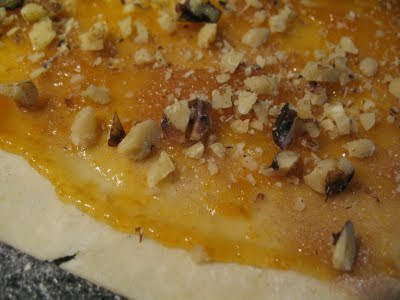


Rugelach
adapted from a family recipe
yields 64 small cookies
Since I first posted this recipe, Ive since changed my technique, brushing the rolled rugelach with an egg wash, and then sprinkling them additional cinnamon-sugar. Either way is delicious.
Dough:
3 cups flour
1/2 tsp salt
2 Tbsp sugar
1/2 lb cold butter, cut into tablespoon-sized cubes
1 cup sour cream
1 tsp vanilla
Filling:
1 1/3 cups apricot jam
1 1/3 cups finely-chopped walnuts
1/4 cup cinnamon-sugar (1/4 cup sugar mixed with 2-3 tsp cinnamon)
In a bowl or a food processor, mix together the flour, salt and sugar until combined. Add the butter, and pulse in the food processor or cut with a pastry cutter (or two knives) until it is reduced to bits that are about half the size of a pea. If using a food processor, dump the contents into a bowl at this point. Stir the vanilla into the sour cream. Using a spoon, and then your hands when needed, knead the sour cream and vanilla into the flour mixture until it is well incorporated, and the dough holds together when you squeeze it. Stop as soon as this is possible — do not over-mix. Shape the dough into four chubby disks, cover with plastic and allow to relax in the refrigerator for at least one hour (overnight is fine too).
Preheat oven to 350 degrees, and line two cookie sheets with parchment or liners (very important, as the molten jam tends to solder them to a pan).
Take a disk of dough out of the refrigerator, and place on a floured countertop or pastry mat. Roll out to a 12" circle, trimming off the ends if needed. This dough is much softer than a traditional pastry crust, so you shouldnt need to let it warm up before rolling. Spread 1/3 cup apricot jam over the round of dough, and sprinkle with 1/3 cup nuts and 1 Tbsp cinnamon-sugar. Taking a chefs knife or pizza cutter, divide the dough evenly into 16 wedges. Starting from the wide base of each wedge, roll towards the center to form a crescent. Place on a cookie sheet lined with parchment or silicone liner, making sure that the tip of the crescent is pinned underneath to prevent the cookie from unrolling. Bake until the filling is bubbling and the crust is just beginning to color, about 30 minutes. Remove to a rack to cool, being careful of the hot jam. Best enjoyed the day they are made (any leftovers are best kept in the freezer).
Friday, July 18, 2014
Rosemary Plum Jam
 Home-canned foods, like home-sewn clothes, are not always the cost-saving wonders that their Depression-era backgrounds evoke. As has recently been pointed out, canning can get expensive. But it doesnt have to be. As a canning obsessive, I would like to share my tips for doing it on the cheap:
1. Stock up on Jars
Buying new canning jars can cost about $.75 a jar. Start trolling thrift stores and Craigs List, where theyre generally half that. Yard sales are also huge sources, as people clean the dusty jars out of grandmas house, or make the wise decision not to take several pounds of glassware with them when they move. If you need to buy new, call around to a few places -- prices can vary hugely.
2. Find Free Fruit!
This is the biggest cost saver around. Here in the temperate rainforest of Portland, this can be pretty easy, and new websites are springing up every day to spread the word about urban gleaning. But it can be surprisingly easy to find fruit on your own -- in the past few weeks, Ive harvested sour cherries and cherry plums (more on that below), just by knocking on doors and asking. Some folks are just happy for you to keep the fruit from rotting on their sidewalks. Just make sure to drop off a jar of jam afterwards.
3. If You Must Buy Fruit, Buy in Bulk
Getting friends together for a canning party can be a surprising amount of fun (depending on your definition of fun), as well as helping you net good deals. If youre willing to buy a lot of fruit, 10 lbs, or a full box, farmers markets will often cut you a deal. Hitting the market at the end of the day can also be good, although its something of a crapshoot -- farmers might be sold out, or they might be willing to give a ridiculously good deal on leftover stock (especially perishable fruit like berries).
4. Value Your Product!
Okay, this isnt entirely about thrift, but I feel compelled to share this hard-learned lesson. When you first finish canning, and your pantry shelves are groaning, you may have a false feeling of flushness. You want to share your jewel-like wares, and you seem to have a lot of them. Beware! Jam can go oh-so-quickly, and then its the dead of winter, and you have nothing sweet to fall back on. Im all for sharing the sugary love, but dont go nutburgers with it. I brought jams as gifts to parties where I barely knew the host, even as a tip for my hairdresser, for goodness sake. I think it was only our second cut.

Rosemary Plum Jam
makes about 8 half-pints
Cherry plums are widely grown as ornamentals, with reddish-purple leaves and fruit. Many people dont even know that the fruits are edible, and are happy to let you collect.
6 cups pitted and roughly chopped cherry plums
3 cups sugar
pectin
1 large sprig rosemary
- Simmer fruit with rosemary, add sugar and pectin according to directions (Im especially fond of Pomona Pectin, which doesnt require a particular sugar ratio in order to set). Because our household is somewhat fussy about texture, Ill fish out a few of the scrolled-up plum skins as it simmers. Taste periodically, and remove the rosemary sprigs as soon as the flavor has permeated to your taste. Youre aiming for a light herbal flavor, almost just a scent.
- Pour into sterilized jars, seal and process in a water bath. Although its tempting to artfully place a rosemary sprig in each jar, dont do it! Unless you fancy jam that tastes like pine needles.

Thursday, July 17, 2014
Creamy or not Carrot Fennel Soup

At various times in my office-bound life, I have been part of lunch collectives. I got the idea several years ago, when I was working at NYU and watched some of the grad students in a neighboring lab try to save their meager grad student wages by having lunch together every week. Each day, one student took a turn bringing in food for the group, and then the five of them would cycle through again the next week. Cooking for five twenty-something mouths is definitely a big undertaking. But when you average it over the week, you ultimately end up cooking less, saving money, and eating better.
In years since, Ive brought this practice to bear in a couple of my workplaces. Usually its been limited to once or twice a week, to accommodate varying schedules and available leftovers. But its still a win-win proposition: after establishing the initial ground rules (various food allergies, restrictions, and common definitions of healthy food (we end up being fond of both fruits, vegetables and butterfat)), you sit down with your coworkers to enjoy a delicious glimpse into someone elses kitchen. Even if the meal is nothing more than a homemade soup and salad, its still miles better than the greasy takeout options in walking distance. But for me, really, it comes down to something else: an excuse to indulge in some dairy.
Living with a someone whos lactose intolerant, Im probably much healthier than I would be if left to my own devices. But Im also left with a powerful craving for cream. Last week I made this soup for lunch club, which fulfills both dietary preferences at once: on its own, it is vegetal and lovely, with sweetly soft-cooked fennel and carrots touched with a bit of fresh orange juice. But for others (like myself and my lunch club), stirring in just the tiniest bit of sour cream gives it a lovely, complex, barely-there tang, giving its lightness a bit of balancing heft. I felt compelled to round out my lunch club contribution with a batch of broccoli-cheese knishes and some cookies (were still in the impress-the-co-workers first round), but it would be lovely on its own, with just a bit of crusty bread and a salad if you want.
And I must belatedly amend last weeks post: I talked about a dramatic chocolate dessert, and lamented that, barring this confection, my life tends to be free of sitcom-worthy drama. But while away at the beach this weekend, I was reminded of a jaunt to a friends parents beachfront cottage last year, wherein one of the guests used hand dishwashing soap instead of the meant-for-machines version in the dishwasher. Acres of suds spilled across the floor. To be fair, the machine didnt walk itself across the kitchen, nor did this occur as we were frantically trying to clean up after throwing an ill-fated party while our parents were out of town. But still: drama!

Creamy (or not) Carrot Fennel Soup
tweaked from Amanda Hesser in The New York Times
yields 2 quarts
2 Tbsp olive oil
2 medium fennel bulbs, washed and thinly-sliced
3 lbs carrots, peeled and sliced into fat coins
2 cloves garlic, thickly sliced
~ 6 cups water or stock (or half of each) - honestly I forgot to measure this ingredient, and details on freestyling are below
1 tsp salt
1/3 cup fresh-squeezed orange juice
dash maple syrup
1/4 cup sour cream
salt and white pepper to taste
Heat the oil in a large soup pot over a medium flame. Add the fennel, carrots and garlic and cook, stirring occasionally, until they soften and just start to color (~10-20 minutes, depending on how large your pot is). Add the water/stock until it just covers the vegetables. Bring to a boil, and then lower the heat until its just high enough to maintain a simmer. Simmer uncovered until the carrots are meltingly tender, ~45 minutes. Longer doesnt hurt.
Let the soup cool slightly, and puree in batches (I prefer it just shy of smooth). Place it back in the pot, and add additional broth/water as needed to get a nice consistency. Add the orange juice, maple syrup, sour cream, and salt and pepper to taste. Serve hot.
Subscribe to:
Posts (Atom)