Friday, June 6, 2014
Pasta with V8 Sauce
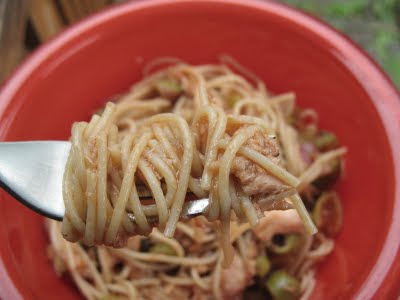
Bear with me here. I know that this title doesnt immediately conjure up images of a delicious dinner. But trust me. This is great. True, its made of decidedly non-gourmet ingredients, and certainly doesnt fit anyones definition of authentic Italian. But if you have a little faith, youll discover what I consider to be the King of Pantry Meals.
Although few Italians begin cooking by cracking open a can of a Campbells vegetable blend beverage, the flavors in this recipe arent too far off tradition. Spaghetti Al Tonno is a typical Italian meatless dish, featuring pasta tossed with tomato sauce and oil-packed tuna. Its a simple meal, and comes in many variations. And this dish fits right in among them. Sure, youre measuring out a commercial drink rather than stewing your own tomatoes. But its a drink featuring a strong tomato flavor, along with the celery and carrots found in some tomato sauces. Chile flakes add some heat, the capers and olives add a nice piquancy, and the oil-packed tuna gives the dish a meaty heft. I was skeptical of this recipe I first encountered it, but it quickly got the thumbs-up in our household. Now I try to make sure were always stocked with the ingredients to throw this together on a busy weeknight.

Pasta with V8 Sauce
serves 4-6
adapted from the Spaghettini with Tuna and V8 Sauce in Nancy Silvertons A Twist of the Wrist: Quick Flavorful Meals with Ingredients from Jars, Cans, Bags and Boxes
Ive tinkered with the quantities in the original recipe, upping the sauce-to-pasta ratio, and increasing the overall yield to ensure leftovers. And although Italians would scoff at the combination of fish and cheese, I sometimes top my serving with a bit of grated Parmesan.
1 14-oz package spaghetti
2 Tbsp olive oil
1 small onion, finely diced
1 stalk celery, finely diced
2 cloves garlic, minced
1 large pinch chile flakes
2 cups V8, or other tomato/vegetable juice
2 6-oz cans oil-packed tuna (dont drain the oil)
2 Tbsp capers
1/4 cup green olives, coarsely chopped
pepper
In a large pot, boil water and cook pasta according to the instructions on the package.
While the water is coming to a boil, heat the olive oil and onion over medium-high heat in a large pot. Saute until the onion is just translucent, about 4-5 minutes. Add celery, garlic, and chile flakes, and cook for a few minutes until the garlic is softened and fragrant. Add the v8, tuna and its oil, capers and olives. Stir, bring to a simmer, and reduce heat to maintain a simmer. Allow to simmer while pasta continues to cook.
When the pasta is cooked, drain it and add it to the sauce. Continue to simmer for a few minutes, to allow the pasta to absorb the flavorful sauce. Season to taste with pepper and salt if needed (although the capers and olives and V8 will probably be salty enough). Enjoy.

Thursday, June 5, 2014
Homemade Peeps

Dont let nobody say I dont aim to please. After last weeks Passoverpalooza, I now bring a bit of Easter love. In the form of homemade Peeps (or, as the litigation-happy Just Born candy manufacturer would prefer I call them, marshmallow chicks).
The New York Times recently came up with a similar marshmallow menagerie, in flavors as delicious-sounding as saffron-honey and green tea-ginger. But boring old me, I went with the classic vanilla variation. And while the cookie-cutter version is much, much easier, I wanted a piped marshmallow (the kind that sets up well when squeezed from a bag), to get chicks that sat upright, with tapered-off beaks and upturned tails. This does not come without its price. Namely: its a big sticky mess.
But if youre willing to deal with marshmallow fingerprints all over your kitchen, you can make these delicious chicks. If my experience is to be universalized, you may initially be a bit dismayed at how your poor motor control leaves you with lopsided little lumps of chicklets. But then you will show them to your friends in despair, and your friends will kindly overlook their shortcomings, and instead ooh and aah over the homespun cuteness. And then theres the delicate texture, just a whisper of sweet foam, a far cry from industrial staleness. You can find my painfully detailed recipe at The Oregonian.

Wednesday, June 4, 2014
Charred Tomato Chile Salsa

For most of us, when we think of making salsa, we think of pico de gallo. Chopped fresh tomatoes, chopped fresh cilantro, onions or scallions, maybe a fresh hot jalapeno or serrano, and then a splash of lime or vinegar to pull it all together. Perfect with tacos, or for scarfing down with chips.
But theres another kind of salsa out there: the cooked salsa. Im not talking about the jarred stuff at the grocery store, which mostly tastes of canned tomatoes. Im talking about the salsas served in squeeze bottles at your local taqueria. The green salsas, tangy with tomatillos. And oh, the red salsas. For a while I had no idea how these were made. You couldnt really identify individual ingredients within the smooth blend. Every now and then you saw a chile seed, or a fleck of charred something-or-other, but for the most part it was a spicy mystery.
It turns out that this class of cooked salsa is easier to make than youd think (or than Id thought, at any rate). You need a fruit to carry the body of the salsa, generally a tomato or tomatillo (unless youre braver than I am, and can go it with just chiles). The tomatoes/tomatillos are seared, and the chiles can also be seared too (although it tends to result in choking smoke), and maybe an onion or garlic. Everything is soaked or simmered, then pureed, with some vinegar or lime to brighten it up, and fresh herbs stirred in at the end. This post gives a great overview of the process.
For a while, I was partial to a variation from the New Vegetarian Epicure, with guajillo chiles and tomatillos. But this version, from Chow, is my new love. Its adapted from a taqueria, Papalote, in San Franciscos Mission neighborhood. Ive been there, and can vouch for it: fairly standard burritos, amazing salsa. I dont know how Chows recipe compares to the original (they had to freestyle it themselves), but its definitely my current favorite. Its spicy from the chiles (sharp Chiles de Arbol and a richer Pasilla), but is mellowed out by pumpkin seeds, which give it a smooth body and slightly nutty flavor. The interplay of caramelized tomatoes and vinegar gives it a perfect sweet-tart balance. Weve had it on top of tacos, on top of chips, and straight from a spoon. Even a chile wuss like me cant stay away.

Charred Tomato Chile Salsa
adapted from Chows Ersatz Papalote Salsa
makes about 2 1/2 cups
Although the recipe is written for Roma tomatoes, I used the Stupice tomatoes in our garden, and it worked wonderfully. Just reduce the amount of water if youre using a juicy tomato (you can always add more later). And if youre a pumpkin seed-lover like me, resist the urge to add more to the sauce. The amount as written provides just the right amount of balance, without making it overwhelmingly nutty.
5 medium Roma tomatoes, cored and halved (or an equivalent amount of other tomatoes)
10 dried Chiles de Arbol, stemmed and seeded
1 dried Pasilla chile, stemmed and seeded
2 tsp kosher salt
1 tsp sugar (less, if your tomatoes are particularly sweet)
1 1/2 cups water (less, if youre using juicy non-Roma tomatoes)
2 Tbsp hulled pumpkin seeds, toasted
2-3 Tbsp white vinegar
1/4 cup minced scallions
1/4 cup chopped cilantro
- Preheat your broiler. Place the tomatoes in a greased baking dish, skin side up. Char under the broiler until the skins are slightly burned, and the tomatoes have started to give up their juice a bit (this can take just a few minutes).
- Slide the tomatoes into a saucepan, along with the chiles, salt, sugar, and water. Bring to a boil, then reduce heat to simmer for 20 minutes, stirring occasionally.
-Add the vinegar, cook for another minute, then turn off the heat. Add a scoop of this mixture to a blender along with the pumpkin seeds, and puree until almost totally smooth. Add the remainder, and puree until smooth (you want the pumpkin seeds totally blended into the body of the sauce, but specks of chile and such are fine). Stir in the cilantro and scallions, and taste to adjust seasoning. Allow to chill for several hours, for the vinegar to mellow and the flavors to meld. The salsa will thicken a bit the first day, and considerably the day after (if theres any left).
Tuesday, June 3, 2014
Porridge!

My college was located in the same town as a Malt-O-Meal processing plant, churning out boxes of hot cereal. On clear, crisp days — especially in the fall — there would be this lovely toasty smell in the air. Like bread, but slightly sweeter. Reassuring, comforting, and somehow a bit encouraging. Like hot cereal itself. Theres something about the toasty smell that still reminds me of that time, of clear fall afternoons and being young and the terrifying sense of possibility of it all.
I havent had a bowl of Malt-O-Meal in years — perhaps not since college. But Im a big fan of the surprisingly wide world of porridge. And if you think beyond the box, and beyond oatmeal, you can find all sorts of delicious porridgey inspiration. Even if you dont have the same adolescent associations, its still enough to warm your belly and soul. I give a rundown of the wide world of porridge (including the amaranth porridge with mango, coconut, lime and ginger pictured above) over at NPRs Kitchen Window.
Monday, June 2, 2014
Chickpea and Kale Soup

In a lot of ways I am a big hippie. I store my bulk-bought rice in cleaned-out tomato sauce jars (poured through my trusty metal canning funnel, no less), and I sleep under a threadbare quilt stitched together from old fabric samples. But when it comes to food, hippies and I have some issues. Sure, I have eaten my share of tofu and tempeh. But there are so many areas where hippies are dead wrong. Like telling you that nutritional yeast is an acceptable substitute for grated cheese. And insisting that you should never, ever salt your dried beans until theyre finished cooking.
A recent article helped bust open this hippie myth for me. Cooking beans with salt is my new favorite thing. And not just cooking them with salt — soaking them with salt. Although the good old hippie cookbooks warn that salt toughens bean skins, its actually quite the opposite — advance salting helps soften bean skins, yielding beans that cook up evenly, consistently, and, most importantly, full of flavor.
Recently I put this newfound briny knowledge to good use by cooking up some chickpeas for a delicious soup. After a salty soak, beans are simmered with a bunch of aromatics and a glug of olive oil (and a bit more salt). A few of them are pureed with the two full bunches of kale, which yields a ridiculously green and flavorful base, and the rest of the beans bob along in the broth. Its clean yet satisfying, full of bright green flavor but also a protein-rich depth. So what turns such a simple preparation into one of the best soups Ive tasted? Is it the kale? The olive oil (toned down from the original 1 1/2+ cups called for, but still)? Or is it the salt?

Chickpea and Kale Soup
adapted from Frannys: Simple Seasonal Italian
yields ~8 servings
2 cups dried chickpeas
1 carrot, peeled and cut into large chunks
1 celery stalk, cut into large chunks
1 onion, peeled and halved
11 garlic cloves
5 strips lemon peel
1 rosemary sprig
1 tablespoon kosher salt, or more to taste
3 quarts water
~1/2 cup olive oil (this is toned way down — if you want the full effect, throw in a full cup with the cooking beans)
¼ teaspoon dried chili flakes
2 bunches Tuscan kale
Freshly cracked black pepper
Lemon wedges
Finely grated Parmigiano-Reggiano
1 carrot, peeled and cut into large chunks
1 celery stalk, cut into large chunks
1 onion, peeled and halved
11 garlic cloves
5 strips lemon peel
1 rosemary sprig
1 tablespoon kosher salt, or more to taste
3 quarts water
~1/2 cup olive oil (this is toned way down — if you want the full effect, throw in a full cup with the cooking beans)
¼ teaspoon dried chili flakes
2 bunches Tuscan kale
Freshly cracked black pepper
Lemon wedges
Finely grated Parmigiano-Reggiano
Place the chickpeas in a large bowl and cover with plenty of water and a hefty spoonful of salt. Let soak for 8 hours or overnight, then drain.
Wrap the carrot, celery, onion, 3 garlic cloves, the lemon peel, and rosemary in a large square of cheesecloth and secure with kitchen twine or a tight knot. Place in a large pot with the soaked and drained chickpeas, the additional salt, the water, and 1/4 cup of the olive oil (alternately, if you dont want to deal with cheesecloth, you can just float all the aromatics in the broth, and fish them out later). Bring to a boil over high heat, then reduce the heat to medium-low and simmer until the chickpeas are tender, about an hour. Add more water if needed to cover.
While the chickpeas are cooking, finely chop the remaining 8 garlic cloves. In a large skillet, heat 2 tablespoons olive oil over medium heat. Add the garlic and chili flakes and cook until the garlic is fragrant but not golden, about 1 minute. Remove from the heat, and transfer the garlic to a blender or food processor.
Remove the center ribs from the kale (or not, if theyre not too fibrous) and coarsely chop the leaves. In the same skillet you used for the garlic, heat a few tablespoons of olive oil over a medium-high heat. Add enough kale to fill the skillet, and cook, tossing, occasionally, until tender (~3 minutes). Remove, and transfer to the blender or food processor with the garlic. Repeat with the remaining batches of kale until its all cooked, adding more oil to the pan if needed.
When the chickpeas are cooked, add 2 cups of them to the blender along with the kale and garlic, and a cup or so of cooking liquid. Puree until smooth. Return the puree to the pot and cook over medium-high heat until hot. Season with salt and pepper to taste.
Ladle the soup into bowls. Finish with a squeeze of lemon and some grated Parmigiano-Reggiano.
Subscribe to:
Posts (Atom)